The idea
Bridges vibrate. Motors vibrate. Floors near factory equipment vibrate. There is power sitting in all of that motion if you can convert it cleanly. Vibro-Volt was my attempt to turn that idea into a working harvester for low-power IoT sensors — something that could power a node without ever needing a battery swap.
The research is decades old; the productisation is still rare. That gap is what makes it a fun student project — there is room to actually try things instead of competing with a polished commercial chip.
PVDF, rectifiers, and a BMS
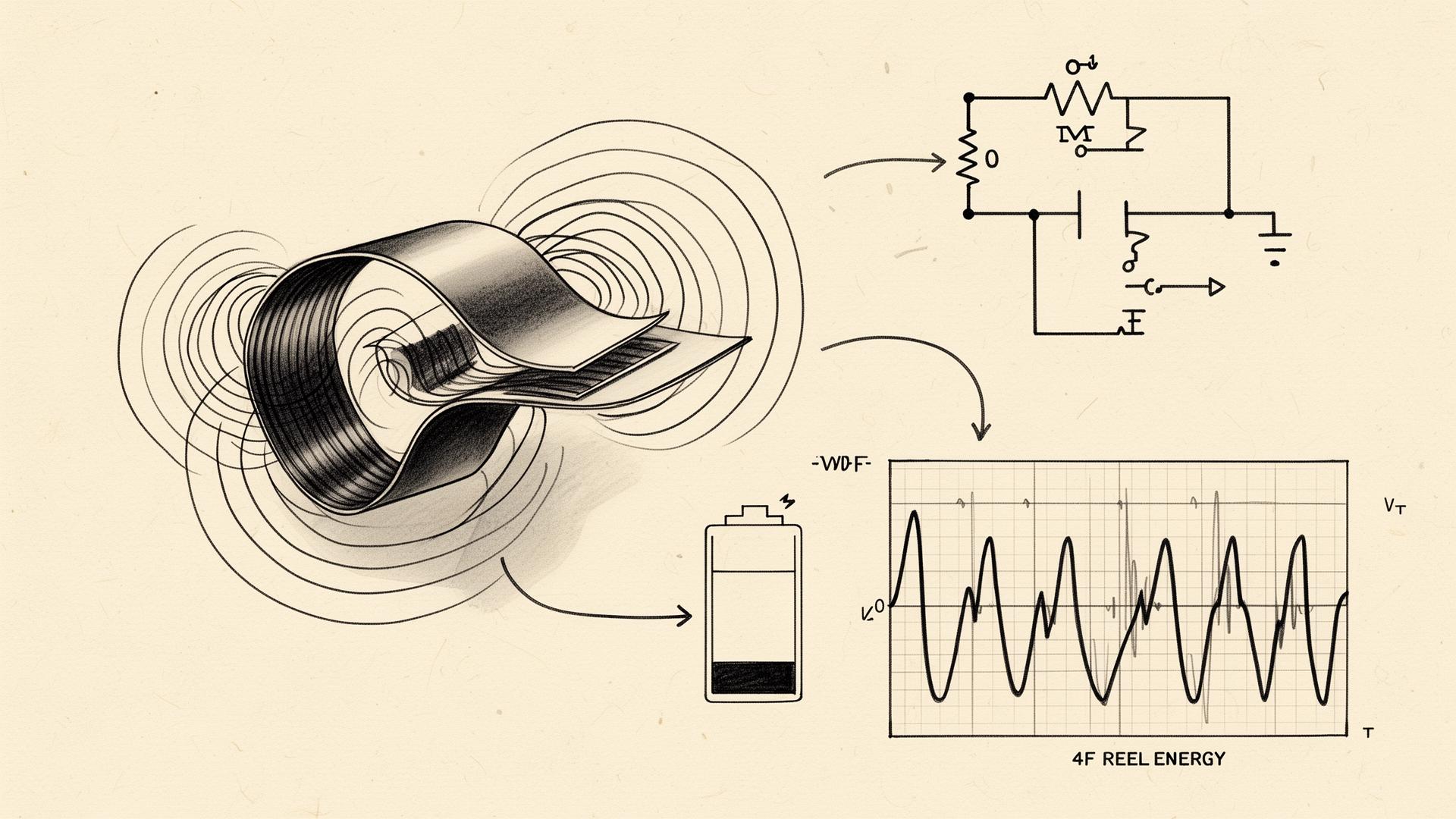
The pipeline is small: a PVDF piezoelectric element generates AC when it flexes, a full-wave rectifier turns it into pulsing DC, a small storage cap smooths it, and a BMS sits on top of a Li-ion cell to manage charge and discharge safely. None of those parts are exotic individually. The interesting engineering is in matching their impedances and protecting each stage from the next one's worst behaviour.
The first version blew up a regulator within an hour because I underestimated the transient spike a piezo element can produce when you tap it hard. Adding a TVS diode and a slightly larger smoothing cap fixed it. Lesson logged.
Interrupt-driven charge control
I built the charge/discharge state machine on an Arduino Nano using ISRs. Polling worked for the proof of concept, but it kept the MCU awake — which is exactly the opposite of what an energy-harvesting node should do.
The redesign was simple: sleep aggressively, wake on a comparator interrupt when the storage cap crosses a threshold, do the minimum work, sleep again. Average current dropped, the harvester actually started keeping up with the load, and the node could run on vibration alone in bench tests.
This is the architecture I would default to for anything battery-or-harvester-powered now. ISRs and sleep modes are not advanced techniques; they are the basic vocabulary of low-power firmware.
Simulation before soldering
I prototyped the rectifier and BMS stages in Proteus before I touched a breadboard. People are dismissive of Proteus, but for a student project where blowing up a real cell is genuinely dangerous, it caught a handful of mistakes that would have been miserable to debug on hardware.
The pattern I follow now: simulate the analog chain, breadboard the safe parts, only solder once the breadboard has run unattended for a few hours without any surprises.
Leading a small team
Vibro-Volt was also my first real lead role. Three teammates, overlapping deadlines, a fair amount of disagreement about scope. The technical work was the easy part. The harder part was figuring out who owned which decision and how often we needed to sync without drowning in meetings.
My honest takeaway: short, written status updates beat long meetings every time. We landed on a weekly text-only update plus one focused work session, and the project pace doubled. That habit has stuck around in every collaboration since.
Where this goes
The next milestone is a small wireless sensor node — temperature and vibration — running entirely off the harvester, publishing to MQTT only when it has the energy budget to talk. If that works on a real machine for a few months without intervention, Vibro-Volt graduates from a student project to something I would actually deploy.