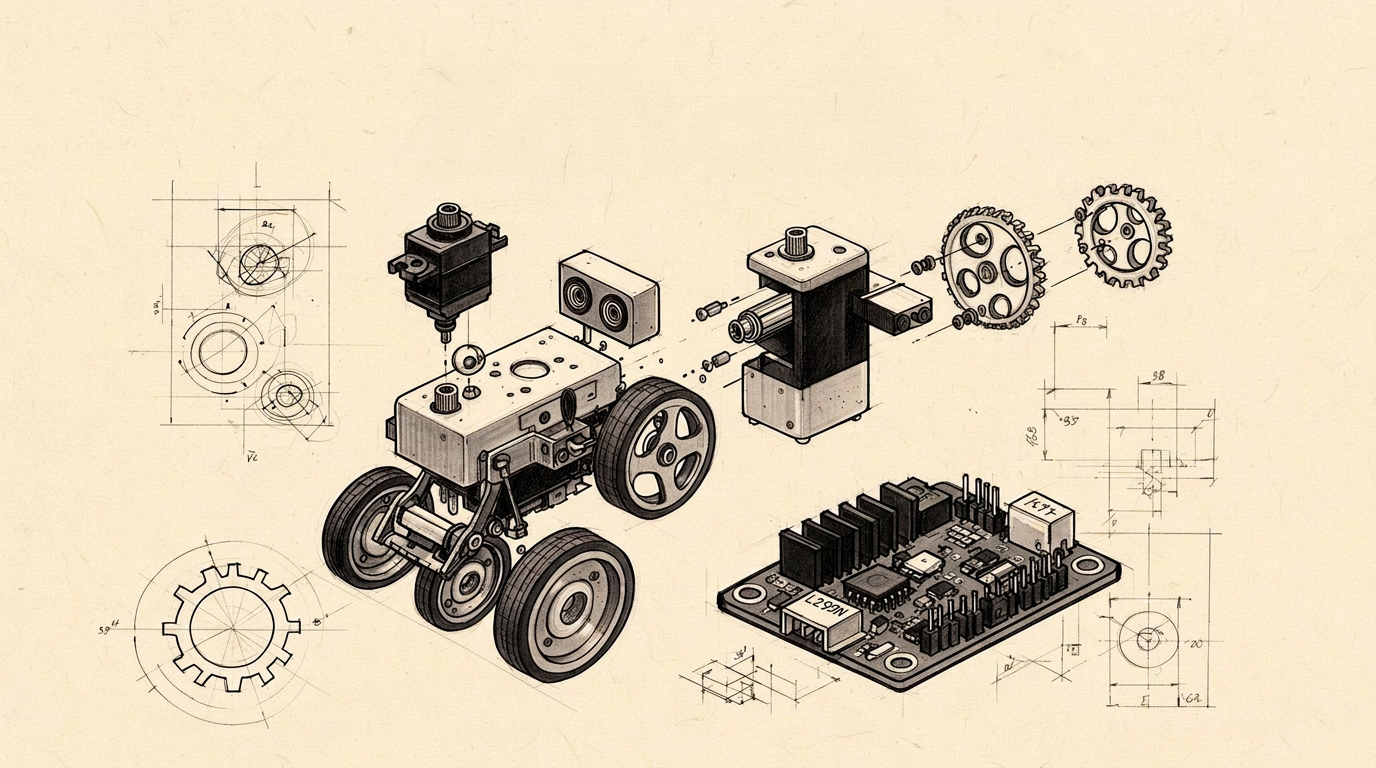
Servo and motor control
PWM-driven servo actuation and L298N motor drive, integrated with ultrasonic, IR and DHT11 sensing — this is the spine of the embedded robotics lab curriculum I help teach. Boring on the surface, deceptively deep when you start asking why the servo jitters or why the motor stalls on startup.
The first time a student asks 'why does my servo twitch when the motor runs?', you realise robotics is mostly electrical engineering wearing a mechanical hat. Shared grounds, brownouts, decoupling caps, motor noise on the analog pins — the bugs are rarely in the code. Once you internalise that, half the mysteries disappear.
Curriculum impact
I have trained 200+ students on hands-on robotics fundamentals — from wiring to interrupt-driven firmware — across multiple cohorts. Teaching the same material to different audiences is the best stress test for whether you actually understand it.
The questions students ask are not the questions textbooks answer. 'Why does my robot drive in a circle when I told it to go straight?' is a richer question than any exam I ever took. Answering it well forces you to talk about motor tolerances, PWM duty cycle, wheel slip, surface friction, and the difference between an open-loop and a closed-loop controller — all in the same five-minute conversation.
A lot of the clarity in my own writing and engineering comes from those classrooms. If you can explain interrupts to a first-year student in under ten minutes with a working example, you understand interrupts.
Hardware that earns its place
Arduino Uno and Nano, L298N motor driver, hobby servos, ultrasonic and IR sensors. None of it is glamorous. All of it survives a classroom of curious hands, which is its own kind of engineering qualification.
I have come to respect hardware that is cheap, replaceable, and well-documented far more than hardware that is fancy and fragile. A classroom is the harshest QA team you will ever meet. Anything that survives a semester there is genuinely production-grade for everyday robotics work.
Where robotics is heading for students like mine
ROS is showing up in more undergrad projects. So is computer vision. So are small-scale autonomous platforms. The cost of building a real, sensing, deciding robot has collapsed in the last five years.
My advice to students stepping into this space: start with one boring robot. Get it to drive in a straight line. Get it to stop when it sees a wall. Get it to log telemetry. Then upgrade one piece at a time. Robots that do everything at once and nothing well are a rite of passage you can skip if you want.